Author: Tihomir Majić & AI Grok
Introduction: Three thinkers, one challenge #
In a world where technology has become the decisive battlefield and artificial intelligence (AI) is rewriting the rules of warfare, the defense of the West is no longer merely a military question – it is a question of ideas, identity and political will.
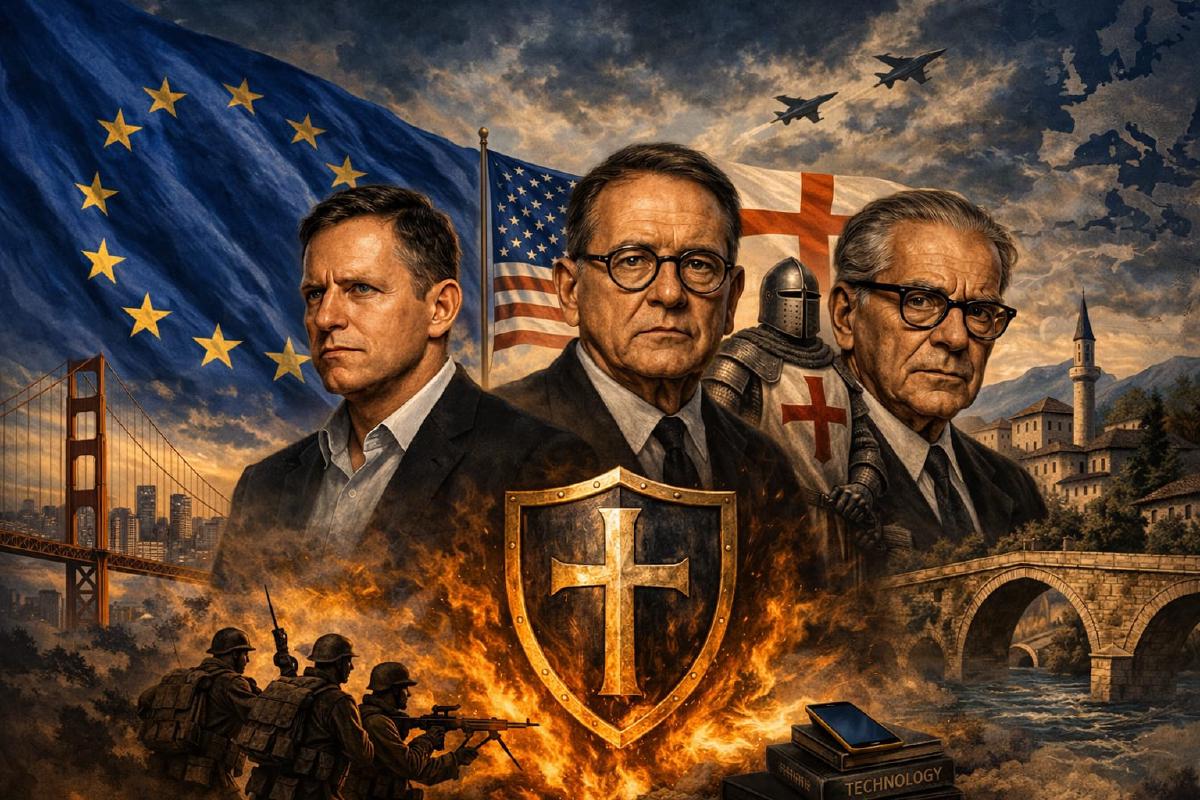
Three thinkers – Peter Thiel, Carl Schmitt and Ivo Andrić – appear at first glance to be incomparable: a technological visionary, a political theorist and a writer. Yet their works and positions reveal a common thread: the understanding that freedom demands decisiveness, that borders are not merely geographical lines but symbols of civilizational identity, and that history is not written by itself – it is conquered and defended.
This essay explores how the ideas of these three thinkers intertwine in the defense of the West, especially in the context of contemporary geopolitical challenges: AI dominance on the battlefield, Chinese technological expansion, and the question of what it truly means to belong to the “free world”.
1. Peter Thiel: Technology as a weapon of uncompromising defense #
Peter Thiel, the American technological visionary of German descent and one of the most influential technology investors, does not believe in the neutrality of technology. For him, AI and data are not mere tools – they are weapons in the global struggle for dominance.
His company Palantir has just become the backbone of American military AI. On 20 March 2026 the Pentagon officially declared the Maven Smart System a “program of record”, which means long-term funding, integration across all branches of the U.S. military, and standardization for targeting, battlefield analysis and rapid decision-making – more than 20,000 active users and thousands of AI-generated recommendations per hour.
Thiel’s approach is without rotten compromises: in an era in which China is developing military AI without any “safety restrictions”, the West cannot afford ideological or ethical dilemmas. Whoever slows down technological and national progress is preparing the ground for collapse. For Thiel, freedom is defended by superior technology, not by moral relativism. This is the practical application of Schmitt’s distinction between friend and enemy: in the civilizational rivalry between China and the United States, technology becomes the frontier between survival and defeat.
2. Carl Schmitt: Borders, identity and political decisiveness #
Carl Schmitt, Ivo Andrić’s friend from their Berlin days in 1940, defined the political through the distinction between friend and enemy. For him, borders are not merely lines on a map but symbols of sovereignty and identity.
His concept of Großraum (“great space”) envisages Europe as a geopolitical entity that transcends the classic Westphalian system of sovereign states – a supranational order that preserves internal peace through the institutionalization of tensions rather than their abolition. Schmitt’s critique of liberalism and parliamentarism anticipated today’s democratic deficit in the EU: institutions that neutralize conflict and shift decisions to technical levels remain legitimate only until someone else decides on the state of exception.
Schmitt would say today: AI is the new battlefield, and Palantir’s Maven system is an example of how technology becomes an instrument of political decisiveness. Without a clear distinction between friend and enemy, the West loses the battle before it has even begun.
3. Ivo Andrić: History, borders and the sublime dimension of defense #
Ivo Andrić provides the human and epic dimension to Schmitt’s and Thiel’s ideas. In novels such as Omer Pasha Latas and The Bridge on the Drina, he portrays the Balkans as an eternal arena of clashing civilizations, where borders are not only political but also cultural, religious and historical.
Omer Pasha Latas shows how every imposed “peace” sows the seeds of its own disintegration. Andrić’s premonition of the fragility of Yugoslavia (expressed in his conversations with Ljubo Jandrić in 1974) is not pessimism – it is a call to vigilance. His characters, trapped between empires and ideologies, remind us that the defense of the West also has a tragic dimension: technology can be both salvation and doom, but identity and historical awareness must remain unshakable.
Synthesis: Technology, decisiveness and identity in the defense of the West #
The three thinkers complement one another in a single clear message:
- Thiel supplies the technological weapon, Palantir as the modern katechon.
- Schmitt provides the theoretical framework: borders, sovereignty and decisiveness.
- Andrić reminds us of the human cost and the sublime nature of defense.
The West today stands before a choice: either it will, like Thiel, use technology without compromise with those who slow down progress, or it will, ignoring Schmitt’s warnings and Andrić’s foresight, become a victim of its own decadence.
Conclusion: Freedom is not given – it is conquered and defended #
Palantir’s rise is not merely a technological news item. It is a symbolic moment in which the ideas of Thiel, Schmitt and Andrić converge: technology becomes the instrument of defense, political decisiveness becomes a necessity, and history and identity remind us why all of this matters.
In a world in which China does not hesitate to use AI for domination, the West must be decisive: invest in technology such as Palantir, guard its borders (technological, political, cultural) and accept that history does not spare those who hesitate.
Thiel, Schmitt and Andrić warn us in their own ways: freedom is not maintained by passivity. It is conquered and defended – by technology, by decisiveness and by awareness of one’s own identity.